Showing posts with label Self Reliance. Show all posts

DIY Solar Shed Project


Solar Panels

With my new storage shed finally completed, it was time to power it up.  Conventional electrical power was going to be quite expensive to run electrical to my new shed because it wasn't very close to any existing conventional electrical power. Without any inside wiring, it was going to cost between three and five hundred dollars for a grid hook-up and I chose going the solar route as a cheaper alternative.

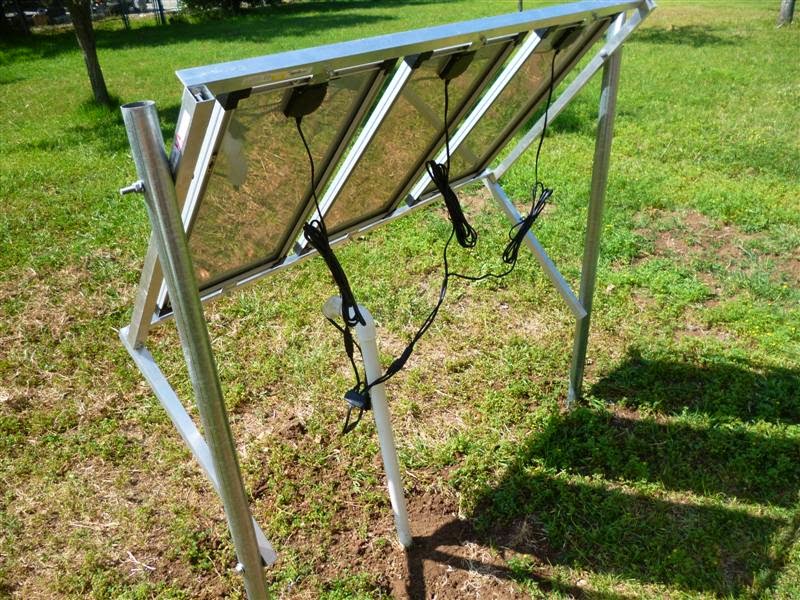
In the picture above are three 10 watt solar panels that were purchased on a close-out special for $29 each. Total cost of the solar panels was $87 plus tax. The panels also came with several additional cables that were cannibalized to wire up my system.


The above pictures show the mounting that was fabricated for the solar panels. The posts are standard chain link line posts (5 1/2 foot). The mounting frame was made from two pieces of one inch aluminum square tubing and two pieces of one inch aluminum angle brackets. All pieces were four foot in length.  The total cost for this was slightly less than $40 but did require some time and effort to put together. A Battery Tender 25' Quick Disconnect Extension Cable  was used to feed the solar panel output into the shed. The cost of the additional extension cable was about $13. A NOCO ISCC2 5-Way SAE Adapter Connector at a cost of about $5 was used to connect the solar panels together. 


This is the underground pipe that feeds the extension cable into the shed. The cost of pipe and fittings was less than $20. The solar panels were only about ten feet from the rear of the shed. They were mounted to keep shade from the roof blocking the solar panels and to avoid rain  from the roof falling directly onto the solar panels.


The above picture shows the charge controller in operation. An HQRP 20A Solar Panel Battery Charge Controller  was chosen because the primary function of this system was to supply light to my shed and this charge controller works well for this purpose. The cost of the controller was slightly less than $30.


The above picture shows the in-line fuse of my connection to the battery from my controller. This is a Battery Tender Ring Terminal Harness with Black Fused 2-Pin Quick Disconnect Plug that connects directly to the solar charge controller. The positive cable in the picture runs to a small 400 watt inverter.


This picture shows my 100 amp battery ( Walmart brand ... $75) and my 400 watt inverter. The inverter is going to be used to power a small fan when working in the shed. The cost of the inverter was $25. It's big enough for it's planned use but a bigger inverter may be added later as money permits.


This is the Cobra 400-Watt 12-Volt DC to 120-Volt AC Power Inverter  that is being used in my system. I used larger cables than came with the unit to lessen current loss and avoid over-heating from using cables that I felt are too small to handle even the light loads that may be placed on this unit. My plans are to not exceed 50% of capacity as a safety precaution and to prevent damaging the inverter. It includes a USB charging port.


This is the charge controller during a load test. In the picture, you can see where the SAE connector to the solar panel input has been disconnected. This triggers the sensor on the charge controller which then opens current to the load connections. This causes the LED light  to turn on.


This is a SainSonic CMP12-10A Solar Charge Panel battery Controller Regulator 10A 12V/24V Auto Switcherspare controller that was purchased as a back-up unit. Just in case!


Any solar power system should be designed for your needs and in such a manner that you don't place unnecessary strain on your equipment. This will insure that it is capable of meeting your requirements. With a little time and effort and slightly more than $250, this system satisfies my needs and should give me good service for an extended period of time. It also doesn't add to the cost of my grid service.

Special thanks go to RW, Jr. who built the shelf that was used hold all the equipment (battery, inverter, charge controller, etc.) and for digging the post holes. 

Got solar?

Staying above the water line!

Riverwalker

Riverwalker’s Book Review - Tribes by John S. Wilson


“Tribes” is John S. Wilson’s prequel to his other survival novels Joshua and Traveler. In this latest edition, John manages to create some thought-provoking survival scenarios that are about as close to what can happen when the grid goes down and everything goes to hell. With a new set of characters, John has been able to create an entirely different set of circumstances to test his new main character, Tom, and his ability to lead a small group in his community as they struggle to survive.

From the paranoid to the psychotic to downright mean and sadistic characters, you will have a lot better understanding of what may happen should you face a similar survival situation.

Sometimes, survival isn't as easy as you may think.

Riverwalker gives ”Tribes”a thumbs up!


Got “Tribes”?

Staying above the water line!

Riverwalker


Riverwalker’s Book Review - Home Remedies


Home Remedies

In time when everyone had to be a lot more self reliant, home remedies where often the only way to treat many minor ailments. Alex Smith in his new book, Home Remedies, seeks to provide you with a guide to some of the more basic and best known home remedies in an easy to reference alphabetical format.
                                                                                                                          
Alex Smith also provides a glossary of some of the more common terms used in home remedies to provide further understanding for the different types of home remedies that are commonly used to treat various ailments. He also provides a fairly comprehensive list of the herbs and plants that are more commonly used in the making of various home remedies.

Although it doesn't include an index, at less than 125 pages it is still easy to find the home remedy you may be looking for due to the easy alphabetical format. The remedies for some of the more common ailments are available at your finger tips.

If you are looking for a quick reference guide to help treat minor ailments, Home Remediesby Alex Smith may be exactly what you need.

Got Home Remedies?

Staying above the water line!

Riverwalker       


Disclaimer: Always consult a medical professional before using any type of new treatments,

Financial Survival - Stuffing the Mattress

With an economy that has been on artificial life support for the last five years, it looks like the government is finally going to pull the plug. We are probably going to be in for the ride of our lives on this financial rollercoaster and you may need a mattress to cushion the fall if you get thrown off.

Many of the benchmarks that are being considered to mark the need for the “taper” of stimulus to our economy may actually be false indicators of our true economic status. The jobless rate shows a decrease but is lead by an increase of part-time workers which is probably due in large part to the upcoming effects of the Affordable Care Act, many of which are probably as yet undetermined.

Artificially low interest rates are probably going to increase significantly and good luck in finding a bank that is willing to loan you money. Most banks are still fundamentally under capitalized and even with a rise in interest rates may be hesitant to loan money to the average individual who is likely to be reduced to part-time status in their job.

The low rate of inflation is also considerably inaccurate when you consider that food and fuel costs aren’t included in government statistics. It is hard to believe that the inflation rate can be considered to be under control when fuel prices have nearly doubled in the last few years and food costs are also significantly higher.

Let’s not forget about the significant increase of the number of individuals that now rely on some form of government assistance in order to merely survive. Many individuals have even dropped out of the workforce because the amounts of government benefits are greater that can be obtained from what used to be characterized as “gainful employment”.

The decrease in the median income of most families is not likely to improve, especially if they suddenly find themselves working part-time. A further reduction in income won’t offset the higher costs of individual healthcare that are also likely to occur. Unfortunately, it appears that our economy is still in a coma and has yet to wake up. It may turn out to be a very rude awakening for everyone.

Essentially, like any individual once removed from life support, you will be on your own and your survival will be at stake. It may be time to start stuffing the mattress to cushion the fall.

Got mattress?

Staying above the water line!

Riverwalker


Disclaimer: This is not to be considered financial advice of any kind and is only an opinion of this author.

Raising Poultry - Using Egg Shells as a Feed Supplement


While there are feed supplements that can be readily purchased from your local feed store, they can increase the cost of raising your chickens. One of the items often lacking in a chicken’s diet is calcium and this can be easily fixed by feeding your chickens crushed egg shells. It is simple to do and can save you a few dollars. It will also solve the problem of eggs with weak shells that break or damage easily.

The first thing you will need to do is thoroughly rinse your egg shells after they've been cracked to remove any remnants of the egg. Once they've been rinsed, allow them to dry in a dish or bowl. Once dried, you can crush them by hand into small pieces and mix in with their grain. This will provide your chickens with the calcium they need to give your eggs strong shells.

Many times people worry about their chickens becoming egg eaters. If your chickens are getting the necessary calcium, this should not be a problem. In fact, a lack of calcium in their diet can actually create this problem with your chickens. Like any animal, they will seek out a source of the nutrients they require.

Chickens also have a natural defense mechanism when it comes to their eggs. They will instinctively protect their eggs from possible predators by eating cracked or damaged eggs in the nest. Cracked or damaged eggs are easily honed in on by predators and could result in the loss of all the eggs in the nest. To avoid this problem, it is a good practice to pick your eggs at least twice a day. This way you will be able to remove any weak or damaged eggs as quickly as possible.

Got egg shells?   
                                                                                                             
Staying above the water line!


Riverwalker                           

Riverwalker’s Book Review and Giveaway - The Pocket Guide to Wild Mushrooms


Foraging for edible foods in the wild can be an important skill that everyone should learn in order to be more self-reliant. Unfortunately, many food items found in the wild can be deadly if you lack the proper knowledge about the items you are foraging. Wild mushrooms are one such item that require a good guide in order to determine if the mushrooms you find are safe to eat.

In The Pocket Guide to Wild Mushrooms by Pelle Holmberg and Hans Marklund, the authors have created a condensed version of their larger book on foraging for mushrooms. This smaller and portable version contains a guide to many of the more common mushrooms found in the wild. It includes excellent pictures of the various types of edible mushrooms that are generally found in the wild. Cutaway views of the mushrooms are also included in order to help you further properly identify your wild mushrooms.


Amazingly, this is one pocket guide that actually fits in your pocket, even if it is a little tight. This makes it a lot easier to keep handy when you are out foraging for edible mushrooms. The guide also offers some helpful tips on cleaning and cooking your mushrooms properly. There is also a small reference section for more extensive information on mushrooms in the wild along with a handy index section for quick reference.

The only drawback of this guide is there isn't very extensive information on where the different edible mushrooms can be found. The guide does reference basic regions and areas where edible mushrooms are found but you may need a larger and more detailed guide for specific varieties of edible mushrooms in your area. This guide does include a very extensive section on beginner mushrooms that can help to get you started in the proper foraging of edible wild mushrooms.

Pockets guides are not meant to be a definite source and while not all inclusive, this is an excellent pocket guide for both beginners and experienced foragers to use when hunting edible wild mushrooms.

The Giveaway

A lucky reader will also win a free copy of The Pocket Guide to Wild Mushrooms direct from the publisher. Just leave a comment about your experience (or lack of) in foraging for mushrooms or other edible food items in the wild. If commenting anonymously,  please leave an identifier in your comment. A winner will be chosen at random from the comments left on this post. The winner will be announced in a separate post on July 31st.

Got pocket guide for wild mushrooms?

Staying above the water line!

Riverwalker


The Prepper Retreat


The need for a prepper retreat should be governed by the use of some common sense planning. The majority of times your present home would be a much better place to “hunker down” if something goes wrong. There may be those times that “bugging out” will be required but that doesn’t mean you will need a separate retreat. There are several qualities for a prepper retreat that will be needed if it is to truly serve your needs and not be an extra burden.

Important Qualities for a Prepper Retreat

1. Accessible. - It’s been said enough times that this part of developing a prepper retreat should be a “no brainer”. Any place you may be considering should be readily accessible in any type of weather. If you can’t get there, it’s not going to do you much good.

2. Affordable. - Any place you may decide to use as a prepper retreat must be affordable. If the cost of a prepper retreat leaves you on the edge of bankruptcy, you may want to consider other options. One option is a group purchase. This allows the cost to be divided amongst more than one person or family. When making a group purchase, there will be extra costs involved for separate surveys and deeds. Everyone involved in a group purchase will need their own place. This was a major cost of my own prepper retreat but it has worked out well. There will be less conflict between group members as a result.

3. Arable. - . A prepper retreat should also have a significant amount of arable land. If you decide to homestead the property, being able to grow food crops will be of prime importance. Certain conditions, like a desert or rocky area, will not lend themselves to a sustainable level of crop production to make adequate food production for your family viable. It will also make it more difficult to raise livestock.

4. Access to Water. - A good source of water or easy access to water will be another necessity. If you have to haul water, you are going to have additional expenses and be doing a lot of extra work. Sometimes even a simple water well can cause unneeded problems that could have been avoided in the first place.

5. Defensible. - This may seem like an odd quality for a prepper retreat but it is a necessary one. If things get really bad, it can become one of the most important qualities that should be considered when deciding if a certain area will make a good prepper retreat. Does it give you the ability to defend yourself properly?

An affordable retreat with easy access that affords you a proper source of water and a significant amount of arable land that is easily defended will make a good choice. The main problem is finding a retreat with all of these qualities. This may not be possible and you may have to settle for something slightly less perfect.

Got prepper retreat?

Staying above the water line!

Riverwalker
Older Post ►
 

Copyright 2011 stealth survival is proudly powered by blogger.com