Showing posts with label Bushcraft. Show all posts

Bushcraft - Central Texas Style - The Artist Conk


The Artist’s Conk (Ganoderma applanatum) is a polypore that ranges in size from a few inches to as much as three feet across. They have a woody, shelf-like appearance with a reddish brown top surface and an underneath (pore surface) that is white and stains to a brown color when marked on or scratched. It gets its name from the fact that the white spore surface can be drawn upon turning it a dark brown color. They are frequently used as a canvas of sorts for artists to render their drawings. They are generally found in clusters on dead or dying hardwoods.


If you need to leave a message for someone, you don’t need a pencil or paper if you have some artist conk in the area. Just scratch a note on the white spore surface.


Often called bracket fungi or shelf mushrooms, this fungus is widely distributed on dead or dying species of oak, elm, and other hardwoods in Texas. Artist conks are perennial and new layers of pores form on the lower surface each year. This give the interior of older artist conks a layered appearance. The interior of the artist conk will also have a velvet like texture.


Artist conks are usually found near ground level which makes them easy to harvest. While this type of conk is normally not considered edible, it does have some other uses that make it valuable. It can be used as a hearth board for starting a fire, burned to repel insects or used as a means to transport a fire when necessary. It can also be boiled as a tea or concoction but this is something I haven’t tried and would advise against.


Unlike tinder conk, artist conk is not a very good tinder material even though it catches fire quite easily when exposed to an open flame. It actually smolders without producing an open flame. If charred, you can get similar results as when using char cloth. Artist conk will smolder for hours and maintain a good set of embers that will allow you take your fire with you.

My preferred use is to repel insects and it works similar to those green coil things sold in stores. Just throw a chunk of artist conk in your fire bowl and you won't have to worry about the insects. This is also a lot better because it’s free.

Got artist conk?

Staying above the water line!


Riverwalker

Bushcraft - Central Texas Style - The Spotted Ground Squirrel


The spotted ground squirrel is a familiar inhabitant that is seen frequently in different areas of West Texas but can also be found in other dry, sandy areas of the state. This ground-dwelling squirrel normally lives in long, shallow burrows in the sand.  A slight mound of sand, usually hidden by clumps of vegetation, is often the only indication of the entrance to their burrows. The average weight of a spotted ground squirrel is between 4 and 5 ounces and they can be as long as 8 or 9 inches if you include the tail. 

These squirrels are quite small and very quick. They are easily missed if you aren't watching carefully because their color blends in with the sand perfectly. These ground-dwelling squirrels are easily identified by the scattered and numerous white spots that can be seen on their backs. The ground squirrel in the above picture was spotted by Lil’ RW, my grandson, who is pretty good at spotting little critters.

One of the primary things you should always be aware of when practicing bushcraft is the type of plants and animals that live and are found in your area. There will be fewer surprises from nature when you do.

Got ground squirrels?

Staying above the water line!


Riverwalker

Desert Survival Skills Practice - Part Two - Water, Wildlife and Plants


Wildlife and plants can be a good indication that water may be present in a desert environment. Water in a desert environment can be an extremely difficult item to locate. Many forms of wildlife would simply cease to exist if they were not skilled in finding sources of water. In addition to the presence of wildlife, plants can also be an indicator of recent rains or the presence of water nearby. 


Many plants in the desert will bloom profusely after a rain. This can be indication of recent rains or a source of water that is nearby. The desert willow is a prime example of this type of plant.


Many animals will also leave signs which indicate their presence. Tracks in a dry stream bed will often give away their presence in the area. Even though you may not see them, you will know they've been in the area.


The dry stream bed eventually entered a closed canyon after about a quarter of a mile. 


At the entrance there was also a creepy crawler in the form of an orange and black millipede. The orange and black coloration is a good indication that it may have had a nasty sting or might be toxic and it was left to proceed to whatever destination it had in mind.


Inside the closed canyon there were numerous pools of water that had collected in the depressions in the rock.


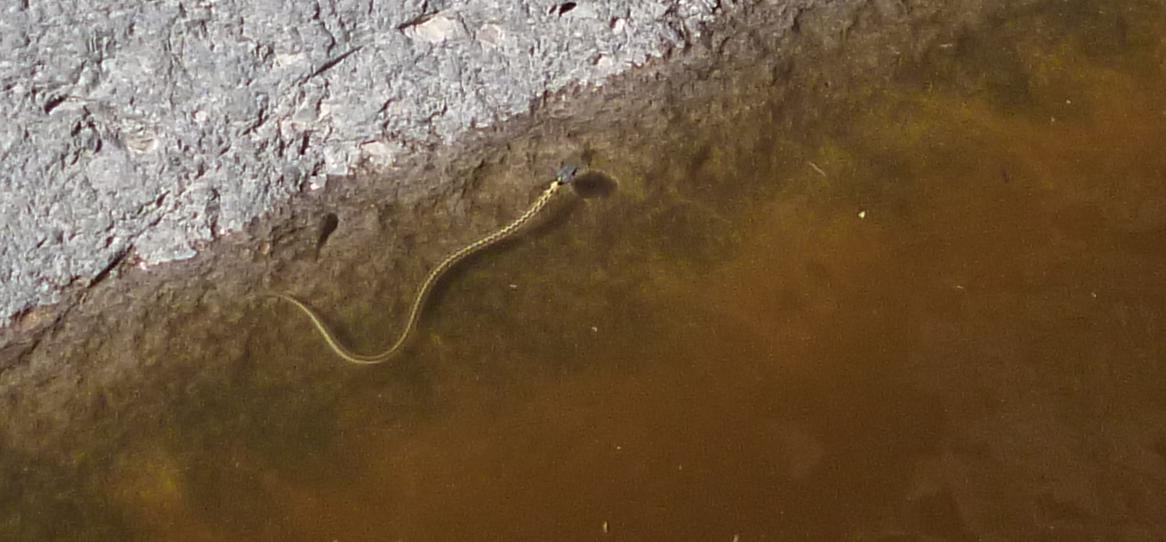
There was also another creepy crawler found in one of the pools. This was a small checkered garter snake. They are also quite harmless, unlike some of the other snakes that reside in the desert.


The dry stream bed which entered the closed canyon continued on for approximately a mile before reaching a fairly steep drop off of 25 to 30 feet which would have required some additional gear to proceed any further. This is commonly referred to as a pour-off.


The drop off fed into the waters of the Rio Grande. Although the river couldn't be seen from the vantage of our starting point, by following the dry stream bed we were eventually led to the river.

Plants and wildlife are always good indicators of your natural environment. When combined with local information and knowledge of the area in which you are traveling, you will be better equipped to handle the challenges of a natural environment.

Nature will always give you the signs you need to survive but you will need to be able to recognize them. 

Got desert skills?

Staying above the dry stream bed!

Riverwalker 

Desert Survival Skills Practice - Part One - Checking the Dry Stream Bed


Dry Stream Bed

Spent some time following a dry stream bed to see if we could locate some shallow pools of water. When checked, the ground was fairly moist just below the surface and several locals indicated that there had been some rain recently in the area. This indicated that there was an extremely good chance of finding a source of water nearby.

Being able to read the signs and then using them to find a source of water can be extremely critical to your ability to survive in a desert environment.

When you're spending some time in the desert, it's a good time to practicing your desert survival skills.

Staying above the water line!

Riverwalker

R and R on the River


On the River

It's time for a little R&R and there's no better place to spend that time than on the river. 

Let you know how the trip turns out later.

 All I really need is a shady spot to rest and recharge the batteries.

Staying above the water line!

Riverwalker

Riverwalker's Pics - Old Highway Bridge at Eagle Nest Creek


Old Highway Bridge at Eagle Nest Creek

Here's a more traditional view of Eagle Nest Creek that shows the old highway bridge in the background. You can also get a pretty good view of the cave located in the canyon.

Staying way above the water line!

Riverwalker

Riverwalker's Pics - Eagle Nest Creek


Eagle Nest Creek

Just a pic from one of my recent trips. This pic was taken in Pecos County near Langtry, Texas.

Staying way above the water line!

Riverwalker

Bushcraft - Central Texas Style - Learning to Hide in Plain Sight


Many times nature is at its best when helping creatures to hide in plain sight. What should be obvious to the eye is not always readily apparent. A little skill in knowing the habits of nature's creatures make them easier to find or avoid. 

One such creature is the Texas spiny lizard. Their coloration allows them to easily blend into their environment but they also maintain a place of safety that is readily accessible should they be discovered. In the case of the Texas spiny lizard, they like to hide in the loose bark of dead trees. All you have to do to discover their presence is peel away the bark to reveal their place of safety.


Here is a closer view of a Texas spiny lizard. They have the ability to remain absolutely motionless, even when exposed to help prevent their presence being revealed. They can also swiftly retreat to a different place of safety when their hiding place has been discovered.

Nature teaches many valuable lessons if you pay close attention to your environment.

Got natural survival lessons?

Staying above the water line!

Riverwalker


Older Post ►
 

Copyright 2011 stealth survival is proudly powered by blogger.com