Showing posts with label Simple Survival Tips. Show all posts

Threats to Survival - Part One - Darkness - Friend or Foe?

Many times the greatest threat to our survival is influenced by irrational fears. While there is some basis to our fears, it is our understanding of those fears which will strongly affect the outcome of our survival. Learning to cope with these fears requires a basic knowledge of why we have developed an irrational response to threats to our survival.

Many of us have a basic fear of the darkness. This is due to a variety of factors from our own life experiences. Tales of the boogeyman when we were young made us fearful of the dark but had little or no foundation in the truth. It was simply a way parents controlled unruly children but their actions also instilled a healthy respect for the dangers that can be encountered in the dark. Many dangers of the dark are real but many of the dangers are ones of our own making.

Simply put, darkness is the absence of light. Thus the ability to conquer any fear begins with a thorough understanding of that fear. This is important in order to develop ways to conquer the darkness that will alleviate our fears. One of our most severe shortcomings is our inability to see in the darkness. Our night vision is extremely poor and pales in comparison to other creatures present in our world. This creates problems when it becomes necessary for us to move about or perform tasks in the darkness. Even the simple task of moving from one place to another can create a dangerous situation. We risk injury from falling or tripping over an object even in the safe confines of our home if we move about in the dark unaided.

The darkness comprises nearly half of our existence and it is necessary to deal with this fact. One of the means to conquer a fear of the dark is to combat it with its opposite. Light can banish the darkness and reduce our fears. A flashlight, a simple candle or a roaring campfire can and will help to reduce your fear of the dark. You have given yourself the means and ability to see things more clearly. Those dangers which lurk in the dark have now been brought into the light and your safety and well-being is increased.

The darkness can hide many things. This is the reason a majority of predators; including the two-legged variety, use the darkness to disguise their movements. The darkness can also be your friend because it can hide your presence or activities if necessary. The important thing is to use the qualities of darkness to your advantage to increase your chances of survival.

The darkness is both friend and foe. While we are basically creatures more accustomed to sunlight, it is your actions and a rational response to the darkness that will ultimately determine the outcome of your survival. Understanding our physical limitations caused by darkness and using relevant actions to overcome them will prevent the darkness from becoming your enemy.

Got dark?

Staying above the water line!


Riverwalker

DIY Survival Gear Tips - Keeping Things Simple

If you find yourself in a survival situation, every person needs to be able to use what they have on hand and take full advantages of what may be limited resources to satisfy their needs.  Each of your resources will have unique advantages and disadvantages. Your main task should be to figure out how to use these items to meet your needs and increase your chances of survival. Here are some simple tips to remember when making DIY survival gear.

DIY Survival Gear Tips

1. Use only the minimum resources necessary.

Making DIY gear is a great way to train yourself to find alternative uses for items to meet these needs. It is important to keep things simple because this often makes things easier to accomplish. It will also help to reduce the amount of your available resources that will have to be used to make your goal a reality. The less hardware that you need to accomplish your project will increase your ability to achieve a successful outcome with limited resources.

2. Use your survival needs as a guide.

Need is a great motivator. Combining a need with a little imagination can usually lead to a successful project. In a survival situation, failure is not an option and simple solutions often work best.

3. Limit your use of power tools and electricity.

Hand tools work even when there is no power available. Try to design your DIY projects to minimize the use of electricity and the need for power tools. If the grid goes down, hand tools may be your only option to complete your project. You don’t want your thinking to be dependent upon grid power that may not be available.

4. Keep your projects simple and uncomplicated.

Complexity can create more problems than it solves. If you make your projects simple and uncomplicated, other family members can assist in the creation and development of any survival gear you may need. If a project is designed with simplicity in mind, you can free up your time to work on other projects. Children and senior family members can also contribute to the process of making needed survival items if you keep things simple.

5. Remember the primary goal of your project.

Your goal should be to create DIY projects that require minimal tools, no electricity, and minimum amounts of hardware or resources. This will help you be better prepared.

Got DIY survival projects?

Staying above the water line!


Riverwalker

Mobility and Survival

Survival can be an impossible goal if we place undue burdens on our physical abilities. This is often exemplified by our attempts to carry every possible item of survival gear we own. The result is that we have created a scenario that will make the goal of survival more difficult to achieve. The old saying “Know more. Carry less.” is a good reminder that will help you avoid this problem. Mobility is directly related to your survival.

Mobility is a key factor in many survival situations. It allows you to remove yourself from dangerous and life threatening situations. It allows you to search for needed shelter, food or water. The inability to move can be the start of a process that will ultimately eliminate any chances you may have had for survival.

Our bodies are remarkable things and we often push ourselves to extreme limits even before we become engaged in a survival situation. This is a dangerous approach that should be avoided and physical limitations must be dealt with prior to finding ourselves in a survival situation.

One of the most difficult things to deal with in a survival situation is an injury. It will slow you down or completely stop you in your tracks. Your chances of survival have almost been completely eliminated. There are numerous examples of things that can be avoided to safeguard against this problem.

A prime example of this is the bug out bag. Carrying a heavy pack can lead to knee or back problems that are a creation of our own making. Military personnel have had to deal with this situation throughout history and many a battlefield was littered with abandoned gear when their survival was at stake. Make sure you cut your body some slack and carry a pack that doesn’t push the limits of your physical abilities before its necessary. While a trained soldier may be able to carry 100 pounds of equipment, it could be a deadly burden for someone without the proper physical ability and training. Know more. Carry less.

Another example of dangers to your mobility is caused by the failure to treat simple injuries. A cut on your hand or foot can cause a host of additional problems you won’t need. Take the time to handle cuts, sprains, blisters and other minor injuries as quickly as possible.

You can also adversely affect your mobility by being improperly dressed. A good pair of shoes or boots is of utmost importance. Many people have a hard time walking even a short distance in their bare feet. Imagine what the effects on your mobility would be if you found yourself with bare feet. The same goes for items such as gloves to protect your hands and a good pair of pants to protect your legs. Don’t forget to include a decent shirt and some sort of jacket appropriate for your weather conditions.

Lee Mastroianni of the Office of Naval Research summed it up very appropriately:

“The ability to move is directly related to the ability to survive.”


Staying above the water line!

Riverwalker


Riverwalker's Pics - Treasure Falls


Treasure Falls in Colorado


Staying above the water line!

Riverwalker

DIY RV Project - Exterior Utilities Hook-up Light


Many times you will find yourself trying to hook up the utilities to your RV at dark thirty. Installing an exterior light on your RV will make the task a lot simpler. It doesn’t matter if you are boondocking or hooking up to a park space. You may find yourself in the dark and fumbling around with a flashlight. An exterior light will leave your hands free to make the process of getting things hooked up a lot easier.

Using a $10 light from the local tractor supply outlet and about 8 feet of two strand 12 volt wire is all you need to accomplish this RV mod. The cover for the power cord was removed and a wire was run from the 12 volt connections inside the RV.  A small hole was then made in the side of the RV for the wire after a suitable location for the light was determined. A piece of coat hanger wire was then snaked behind the siding of the RV until it came out at the side of the electrical cord cover opening. The wire was then hooked to the 12 volt electrical wire and pulled through the hole. It was then a simple process of hooking the wires to the light and mounting the base plate to the side of the RV and installing the light cover.


The light included an on/off switch and the cover was mounted with the switch in the down position. Even though the switch was water resistant, mounting it where it was on the bottom helps avoid rain hitting it directly.

It’s a quick and simple RV mod that can be done in less than an hour.

Got RV mod?

Staying above the water line!


Riverwalker
Solar Garage Project


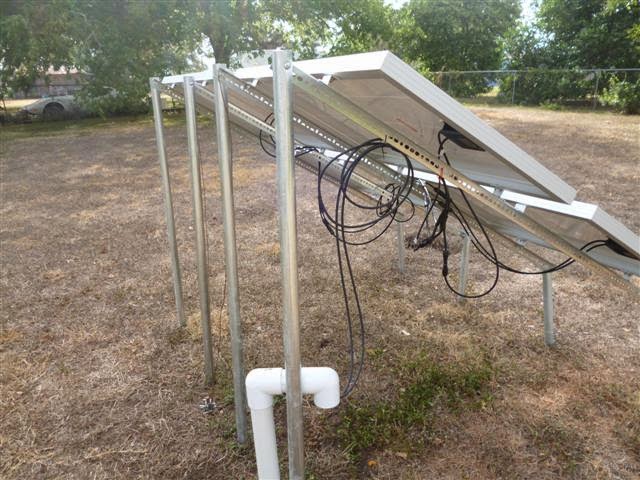
Pole-mounted Solar Panels

The conversion of my garage to solar power is completed and hopefully it will lower my utility bill. It took a while to get everything set up and working. My panels were pole mounted in order to make it easier to service the solar panels.


A total of four 100 watt solar panels were used to charge a battery bank of four 100 amp hour batteries. Two inverters were used to furnish power. A 100 watt pure sine wave inverter was used for lights and to power a small air compressor. An 1800 watt pure sine wave inverter was set up to furnish power for my power saws. This covers the majority of my power usage in the garage. I’ll also being running a fairly low wattage heat lamp for the chickens in the winter.


A solar panel kit from Grape Solar was used for this project and came with most of the necessary wiring, a charge controller and an inverter. There is additional information posted in my product review. A separate grounding rod was installed on the panels and the solar disconnect that was installed.

My grid-powered outlets are still functional and can be used if my solar power system goes down for some reason but won’t be used unless absolutely necessary. With the completion of this project, my storage shed, greenhouse and garage are now on solar power.

Part Two will show my battery bank, solar disconnect and charge controller set-up.

Got solar-powered garage?

Staying above the water line!

Riverwalker

Hiking to Piedra Falls


Piedra Falls

Piedra Falls is located about 30 miles north of Pagasoa Springs, Colorado in the San Juan National Forest. It's a leisurely hike of about 3/4 mile to get to the falls and makes a very pleasant day hike through the forest and along the middle fork of the Piedra River.


Trailhead


Start of the trail in the San Juan National Forest.


Further along the trail it gets a little rocky.


Back into the woods again.


A little shade along the way.


Trail gets rocky again.


Trail runs along the side of the Piedra River as you get closer to the falls.


There's a narrow spot between the rocks as you approach the basin of the falls.


The basin of the falls at the end of the trail.

Got day hike?

Staying above the water line!

Riverwalker


Riverwalker's Wildlife Pics - Chipmunks and Ground Squirrel


Chipmunks and Ground Squirrel

Here's a pic of a couple of chipmunks and a ground squirrel. It was brought to my attention that I had erroneously labeled a ground squirrel as a chipmunk in my previous post. As you can see in the above picture there is a noticeable difference in size and markings.

Got wildlife?

Staying above the water line!

Riverwalker

Riverwalker's Wildlife Pics - Ground Squirrel


Golden Manteled Ground Squirrel 

Got wildlife?

Staying above the water line!

Riverwalker

RW in Colorado - Close Encounters of the Bear Kind


I happened to cross paths with a black bear quite by accident on a recent trip to Colorado. It was quite sudden and totally unexpected on my part as I had just left the trail head for one of the trails in Black Canyon. Apparently the bear noticed us first and had already started moving away from my area. He quickly moved into a brushy area and was gone from sight. I did manage to get a couple of quick pictures as the bear moved away.


Black bears aren't normally aggressive and will leave your area quickly unless they are provoked, feel cornered or are protecting young. Fortunately, this bear was probably intent on his next meal of berries and only gave me a cursory glance before moving quickly out of the area. The bear went into a brushy area and disappeared from sight.

It’s a well known fact that Colorado is bear country and you should always be aware of this fact. A safe distance from predators such as bears, wolves, and cougars is normally about 100 yards (think the length of a football field). Any closer and you may be putting yourself at risk of a serious situation. You can normally approach other wildlife to within about 25 yards without any real concern. Most animals usually won’t allow you to get even that close. The exception is snakes who can normally strike from a distance equal to their length.

There is an excellent brochure in PDF format available at Colorado.gov that contains a lot of useful tips to help take adequate precautions when in bear country.

Here is a link to the brochure:


Got bears?

Staying above the water line!

Riverwalker


Riverwalker's Pics - More High Places


More High Places

Got higher elevation?

Staying above the water line!

Riverwalker

Riverwalker's Pics - High Places


High Places 

Got elevation?

Staying above the water line!

Riverwalker

Riverwalker's Wildlife Pics - Doe Nursing Fawn


Doe Nursing Fawn

While on a recent outing, I took a picture of this mule deer nursing her young.

Got deer?

Staying above the water line!

Riverwalker

RV Boondocking Project - DIY Installation for a Reverse Light


One of the most difficult tasks when boondocking is backing your RV into a suitable area. This can be made even more challenging if you don't have reverse lights on your RV and it's starting to get dark. In many cases, In our case, we usually don't reach our destination until it's gotten pretty late in the day. Without decent back-up lights, you could risk serious damage to your RV.

RW, Jr.'s RV didn't have any reverse lights and it really made it difficult to back-up when there wasn't much daylight left. To remedy this problem, I installed an LED spotlight on the spare tire carrier on RW, Jr.'s RV. If we wind up getting set up late in the evening, we don't have a problem because of a lack of daylight.


.The main obstacle was making a mounting bracket for the light. Replacing the existing taillights with ones that incorporated reverse lights was a pretty expensive proposition and they wouldn't have provided very much additional light. Standard reverse lights aren't very bright and wouldn't be a lot of real help when it gets dark.

I used an old aluminum bracket and a piece of 1/2" electrical conduit that was in my junk pile to fabricate a mounting bracket. It only required a couple of holes to be drilled in the spare tire mounting bracket to attach the light. I mounted it in a centered position that enabled the light to be used to its maximum advantage. This gave the maximum amount of light coverage.  


The light was wired directly into the trailer wiring harness to the reverse light wire which hadn't been hooked up. Now RW, Jr has a spotlight that works any time he is backing up his RV. He can also see me when I'm guiding him into place if it's dark. I used a  10 watt 12 volt  DC LED Floodlight for the reverse light. It's water-proof and puts out a lot of light.

Got boondocking light?

Staying above the water line!


Riverwalker


Wilderness Water


Wilderness Water

Many times when hiking trails you will come upon water sources in the wilderness. This could be a small pond, stream or simply a depression where water has collected. It is important to remember to avoid the problems that are inherent in any source of wilderness water before using it. Any water source should always be filtered and treated to remove any possible contaminants to avoid serious problems that could affect your health and ultimately your survival. 

Simple Survival Tip

Proper water treatment methods should always be used before consuming water from a wilderness source.

Got wilderness water?

Staying above the water line!

Riverwalker

Stay Safe from Summer Storms with These DIY Home Projects

Every day, hundreds of lightning bolts crash down from the heavens onto the earth below. For the Scandinavians, just as thunder was the embodiment of Thor, lightning was the embodiment of the hammer he used to protect humans from the ever-present threat of giants. These days, there may be fewer giants in the woods, but menacing electrical storms can still wreak havoc on your property. Luckily there are many small things you can do around your home to prepare it for the worst.

1. Remove Debris: Broken branches, building materials, lawn furniture, or other loose items around your home have the potential to become dangerous projectiles in the midst of a storm. Take time to assess your backyard and complete any tree removal or limb-trimming you feel is necessary.

2. H2O to Go: If a severe electrical storm is in the forecast, your power grid and city water system might both be at risk of going down. Fill up buckets, bottles, and even your bathtub for washing and drinking. Ice bags in the freezer can also help- a couple days without power may cost you a couple hundred bucks in rotten food. Fill freezer bags with water and keep them in the freezer, then use them in the event of a blackout to help food stay cold longer. When they thaw out, you’ve got clean drinking water. Before the storm, you can also make a rainwater collection system for very little money and store hundreds of gallons of water to use for your garden, plumbing, or other uses.

3. Repair Your Roof: In order to prevent leaks and severe damage to your roof during a downpour, you should carefully inspect your roof gutters and shingles. Doing minor repairs early on is much better than cleaning up the after-effects of indoor flooding. Start by examining chimneys, skylights, and plumbing vents for moisture. Look for algae stains on interior plywood, wet insulation, or rust around nails, since these are some telltale signs of leaks.

4. Solar Sump Pump: For remote areas needing pumping without access to power, a sump pump with solar batteriescan provide the answer. Install a couple of small solar panels to charge the portable water pump’s batteries, and you can go “off the grid” with your portable pump. Some people live in areas where storms may leave them without access to a working electrical grid for weeks or even months; in these cases, it can be very useful to have a battery backup to keep solar electricity in reserve for nights and cloudy days. Solar energy is catching on among many in the United States, and in Canada you can even find alternative eco-friendly energy plans through various informational websites that can let consumers bypass main fossil-fuel based providers altogether.

5. Fill Your Gas Tank: Keep a full propane tank handy so that you and your family can still enjoy a hot meal if you have a gas grill and meat in the freezer. In times of lengthy outages, you can always grill the contents of your fridge before the food spoils. Filling your car with gas before a storm allows you to turn it into an additional survival tool. Cars can be used to charge cell phones, provide heat, and even function as a generator with a power inverter. Your car is also your means of emergency transport and without power, gas stations in your area will be unable to help you refill your tank.

Each storm is unique, and presents its own unique set of challenges, but having some survival tips in mind can help put the odds in your favor. With all the time and money you’ve invested into your property, being prepared is just plain common sense.

Beth Kelly is a freelance blogger from the Midwest and the author of this guest post.

Thanks go out to Beth for some great tips.

Staying above the water line!


Riverwalker

Riverwalker’s Gear Review - Instafire


Being able to start a fire is one of the best skills you can develop. It also usually requires some form of kindling or fire-starting material to make the task of building a fire easier and simpler. You also want to get that fire started quickly before it gets dark. Here’s a quick review of Instafire.


RW, Jr. left me in charge of the firewood for a short boondocking trip we were on and unfortunately my wood pile had gotten wet from a brief rain shower the day before. Wet or even damp wood can be extremely difficult to start a fire without some help along the way. It was time to check out the firestarter product from Instafire.


Instafire is fairly inert and very safe to handle. Although you should be able to start several fires with a single package, I opted to use the whole package. It does start easily with a match or a lighter and doesn’t flare up like charcoal starter or other readily flammable types of firestarters. It comes in a fairly rugged package that still manages to be easily opened by hand. A pile of the Instafire mixture was dumped in my hand and then added to the wood in my fire pit. With a quick flick of my Bic, I had a decent flame going right away.


 It also burns really hot!


Advantages of Instafire:

!. It’s very safe to handle (non-toxic) and doesn’t impart fumes to items being cooked over the fire.

2. It lights easily with a match or lighter. These are the two most common means of starting a fire used by most people on a regular basis in most circumstances.

3. It works well for starting charcoal without the usual fumes from charcoal starter or ashes blowing in the wind from using newspaper.

3. It burns extremely hot and handles large chunks of damp wood with ease.

Disadvantages of Instafire:

!. It can be a little pricey but is available in larger containers to reduce the cost.

2. Although the package stated you could start several fires with a single package, it’s difficult to gauge how much is needed when your wood is wet or damp.

Instafire worked really well to get my fire started. It had no problem with getting my damp wood chunks burning. In less than thirty minutes, we had a decent fire. I probably wouldn’t use it on a regular basis but having some handy in case your firewood is wet or damp couldn’t hurt. It can also help if you have someone that has a low tolerance for some of the other types of chemical firestarters.

Got firestarter?

Staying above the water line!

Riverwalker


Riverwalker's Pics - Black Water


Black Water


Got swamp?

Staying above the water line!

Riverwalker

Using Your Powers of Observation - Hidden Dangers on the Trail


Hidden Dangers on the Trail

While often nearly impossible to detect, keeping your eyes open will often reveal dangers before they become a serious threat. In the pic above there is a copperhead hidden underneath an old tree stump. The markings on a copperhead can make it very difficult to see and its head was hidden in the shadows. This is a potentially lethal encounter if you aren't using your powers of observation. They will sense you before you are even aware of their presence.


Close-Up View

Here is a close-up view of the copperhead coiled underneath the old tree stump. His head is barely visible in the shadows. This picture was taken pretty close to dark thirty and it was probably intent upon finding a meal. It also appeared to be a mature adult and was probably looking for smaller prey. It did seem slightly annoyed and disturbing it further probably would have been a very bad idea.

There are a lot of hidden dangers on the trail. If you aren't observant along the trail or during your hikes, you could have a seriously bad day.

Got powers of observation?

Staying above the water line!

Riverwalker

Riverwalker's Pics - Cicada


Ever wonder where a cicada is hiding? You might want to check the grass at your feet.

Got green bugs?

Staying above the water line!

Riverwalker
Older Post ►
 

Copyright 2011 stealth survival is proudly powered by blogger.com